AI Visibility
A new dimension of Employer Brand: what AI tells candidates about Ukrainian employers
Research, 2026
Candidates used to look for company reviews on Google and job boards. Today, they ask ChatGPT and Gemini instead. Artificial intelligence now decides on its own which companies to recommend to job seekers – and directly shapes hiring outcomes.
Together with VIRSHI, the developer of the Advisly platform, we examined how Ukrainian employers appear through the eyes of large language models. Analysts studied the general market as well as three sectors: agriculture, retail, and finance. Between August 6 and 11, 2026, the models were asked dozens of HR-related queries, generating 8,586 mentions of 1,248 companies and 4,275 source references for analysis.
Here are the key findings of the study.
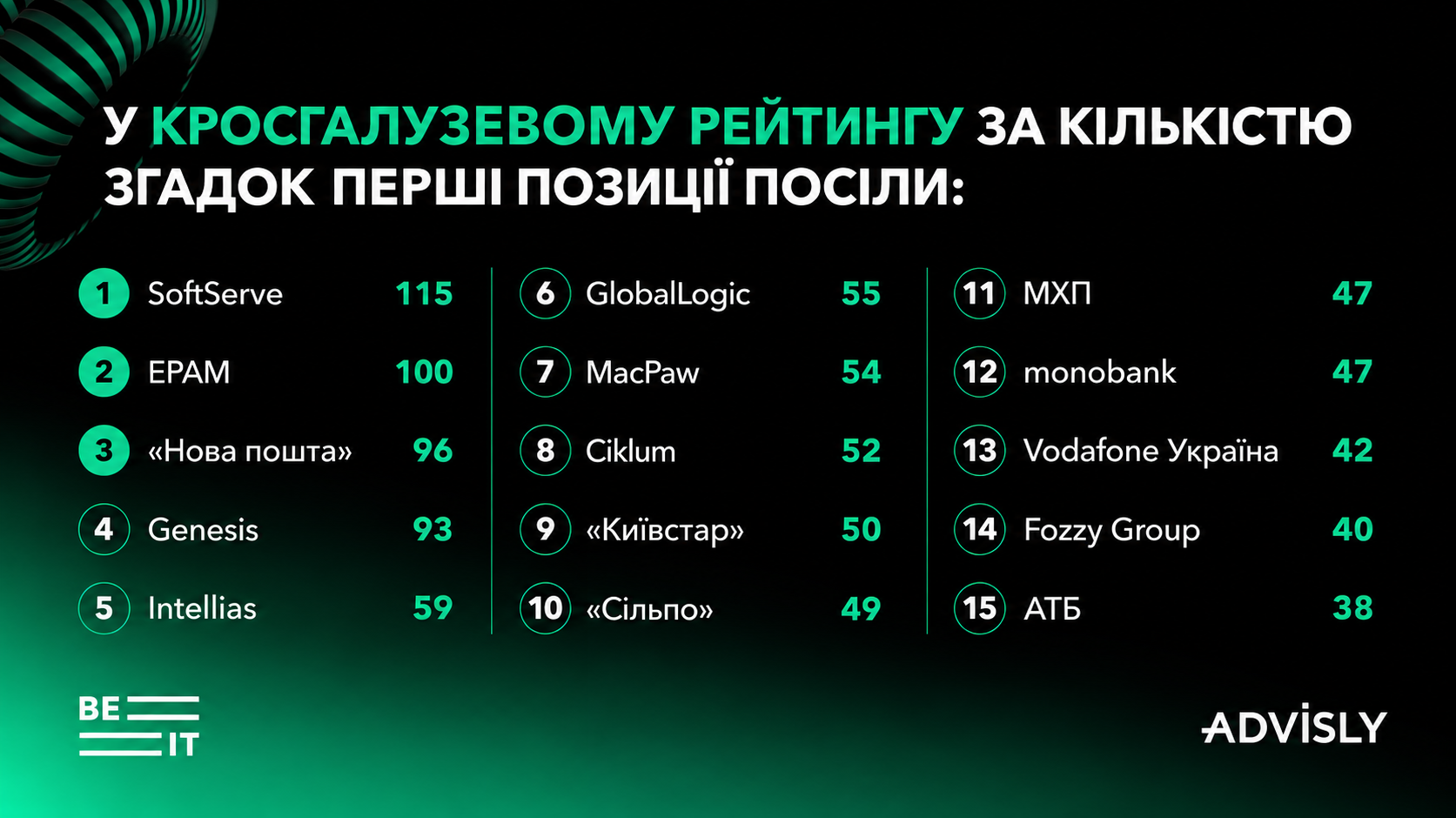
SoftServe, EPAM, and Nova Poshta lead in AI visibility
Seven of the ten most visible employers are IT companies. Only three non-IT brands make the top ten – Nova Poshta, Kyivstar, and Silpo. Nova Poshta is the only non-IT brand in the top three.
Overall, the AI mentioned 1,248 organizations during the study. Yet only 15% of companies appeared in the monitoring every day, while 60% of brands showed up in responses just once during the entire observation period. This shows that AI visibility isn't a static category – it requires ongoing tracking from businesses that want to systematically manage their reputation within large language models.
In AI, every brand can claim its own reputational territory
AI doesn't just rank employers – it links them to specific attributes.
SoftServe – with flexibility, remote work, and mental health support;
EPAM – with salary and benefits package;
Nova Poshta – with fast hiring, low barriers to entry, and the opportunity to start or change a career.
A company doesn't need to top the overall ranking to lead in a specific topic. Kyivstar tops the stability category despite ranking 9th overall. UKRSIBBANK is #1 for corporate culture while sitting 16th in the general ranking. MacPaw is #1 for purpose and mission.
"No brand can be number one across every metric. But almost any brand can become a leader in a specific topic. That's why building an employer's reputation in large language models should start with identifying a few territories the company wants to stand out in, then focusing on those. This way, even a brand with fewer mentions can become AI's first answer to a specific question – about stability, corporate culture, or growth, for example," says Myroslava Hribova, Director of Be–it Agency.
Genesis was the only company in the study to rank in the top 7 across all eight HR topics analyzed, from hiring to mental health.
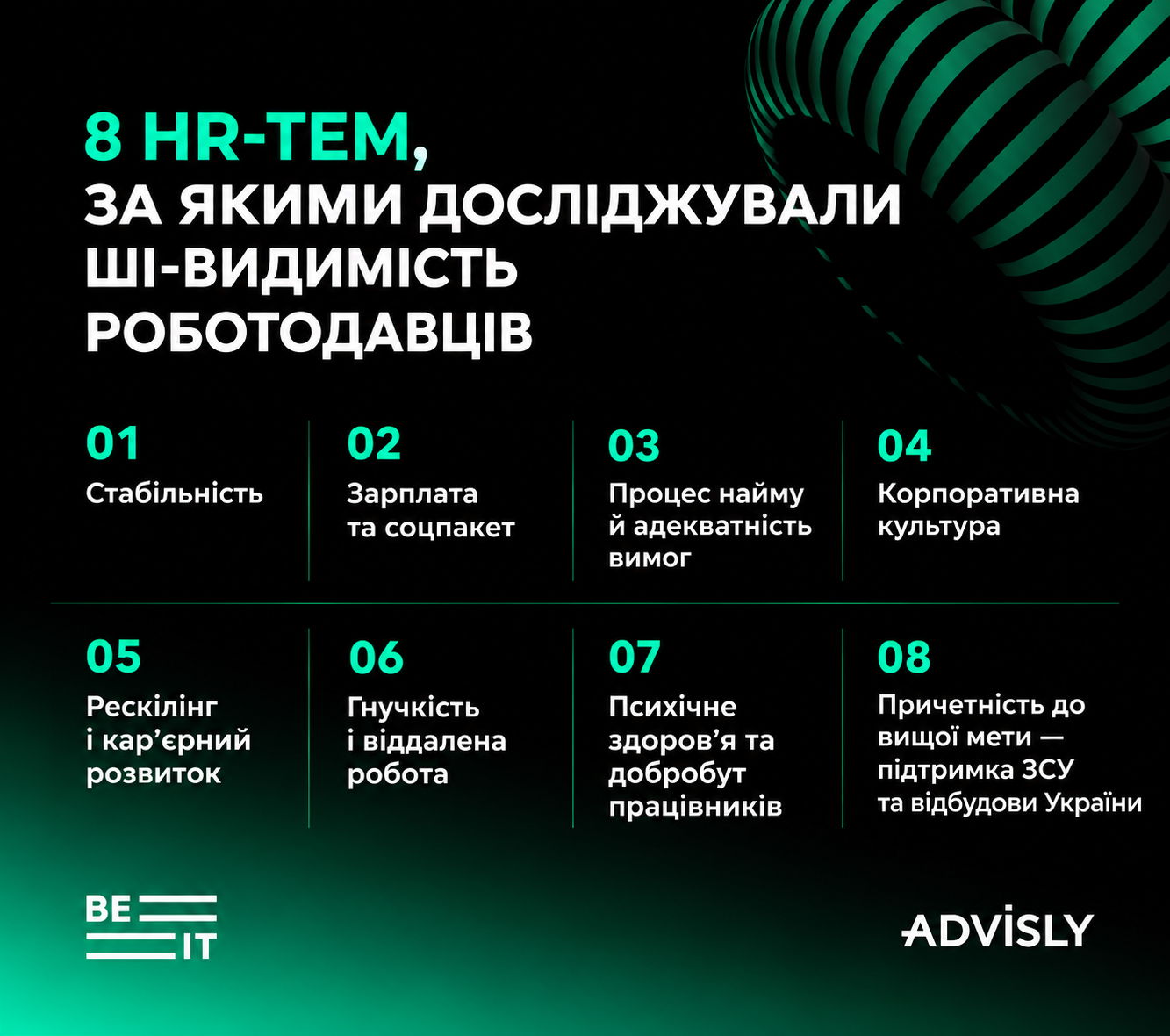
The study found that a high number of mentions isn't an end in itself. Mention count shows how visible a brand is, while associations show what exactly AI knows it for.
So a company can be broadly visible yet lack a clear association. At the same time, a brand with fewer mentions can become AI's first answer to a specific question – about stability, corporate culture, growth, or flexibility, for example.
For employers, this means the work isn't just about overall presence – it's about clear positioning around the topics that matter most to candidates.
Companies compete for candidates beyond their own sector
Among non-IT companies, the visibility ranking revealed a diverse competitive landscape: telecom, retail, agriculture, finance, metallurgy, and energy all appear side by side.
When AI receives an open-ended question – for example, "Which Ukrainian employers offer the best benefits package?" – it first identifies industries known for strong benefits, then names a few businesses within each. This means a bank can compete for a candidate's attention with a telecom operator or a retailer, and an agricultural company can compete with an IT employer. Businesses should therefore take a much broader view of who they're competing with for talent, rather than limiting themselves to direct market competitors.
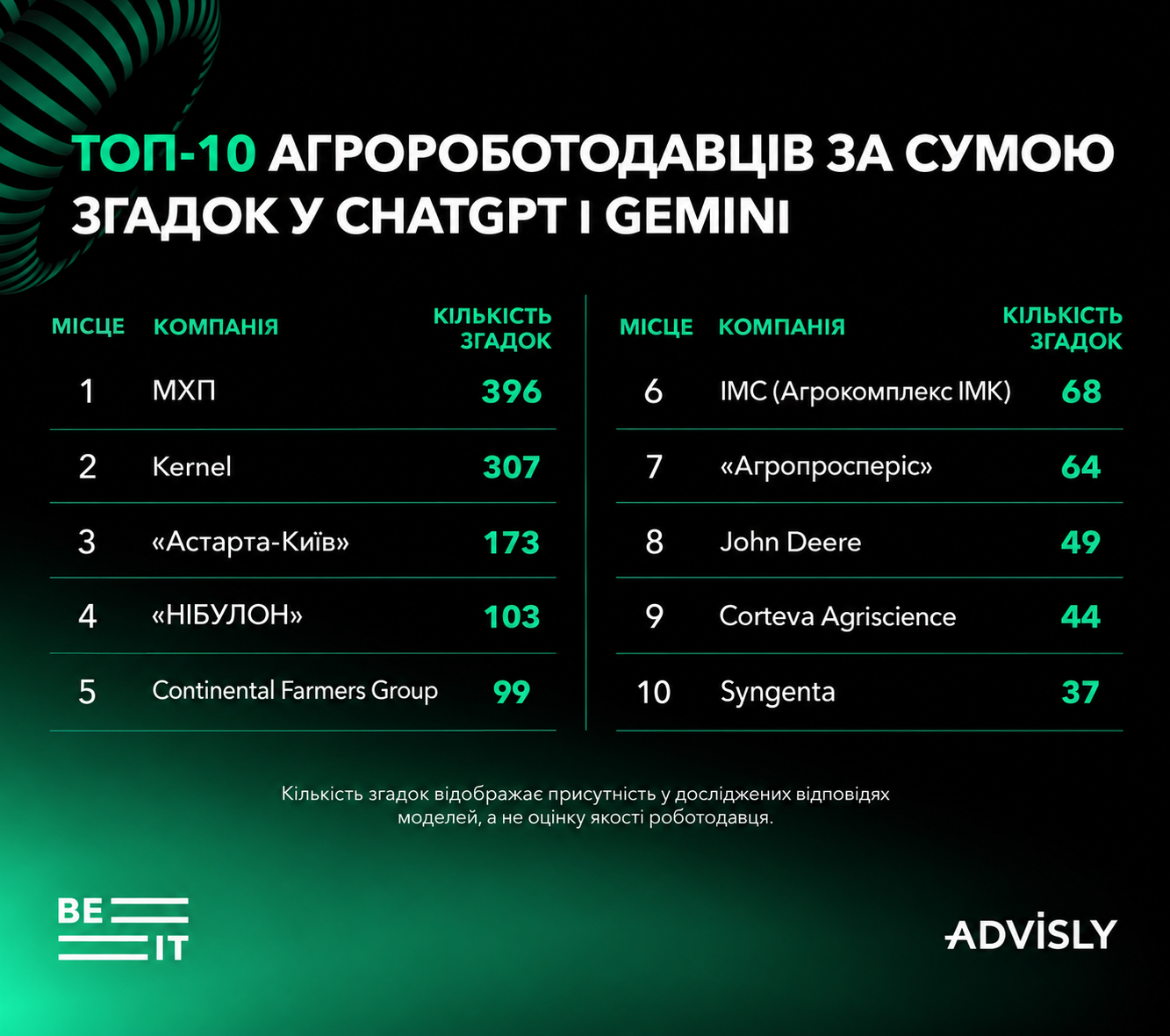
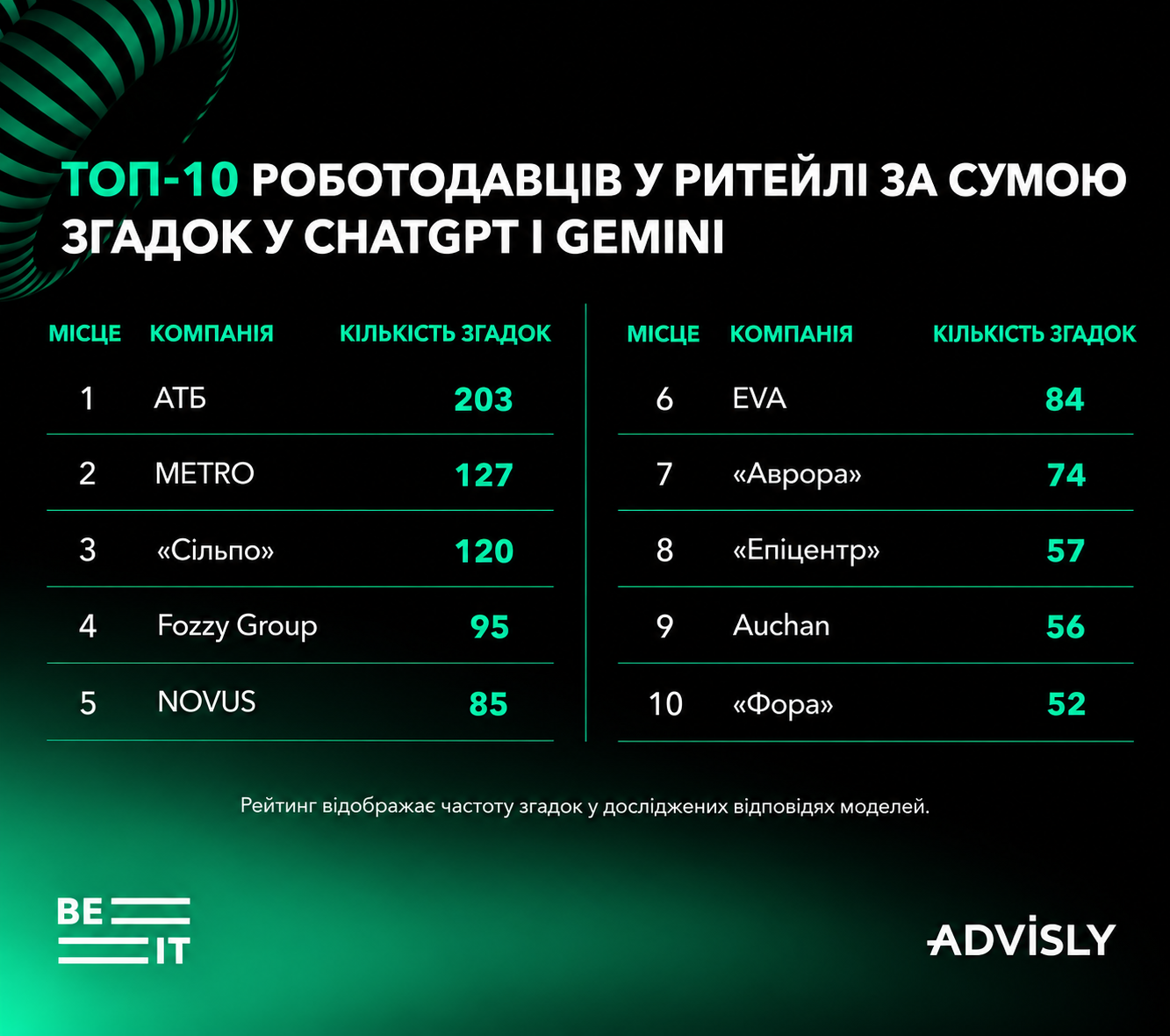
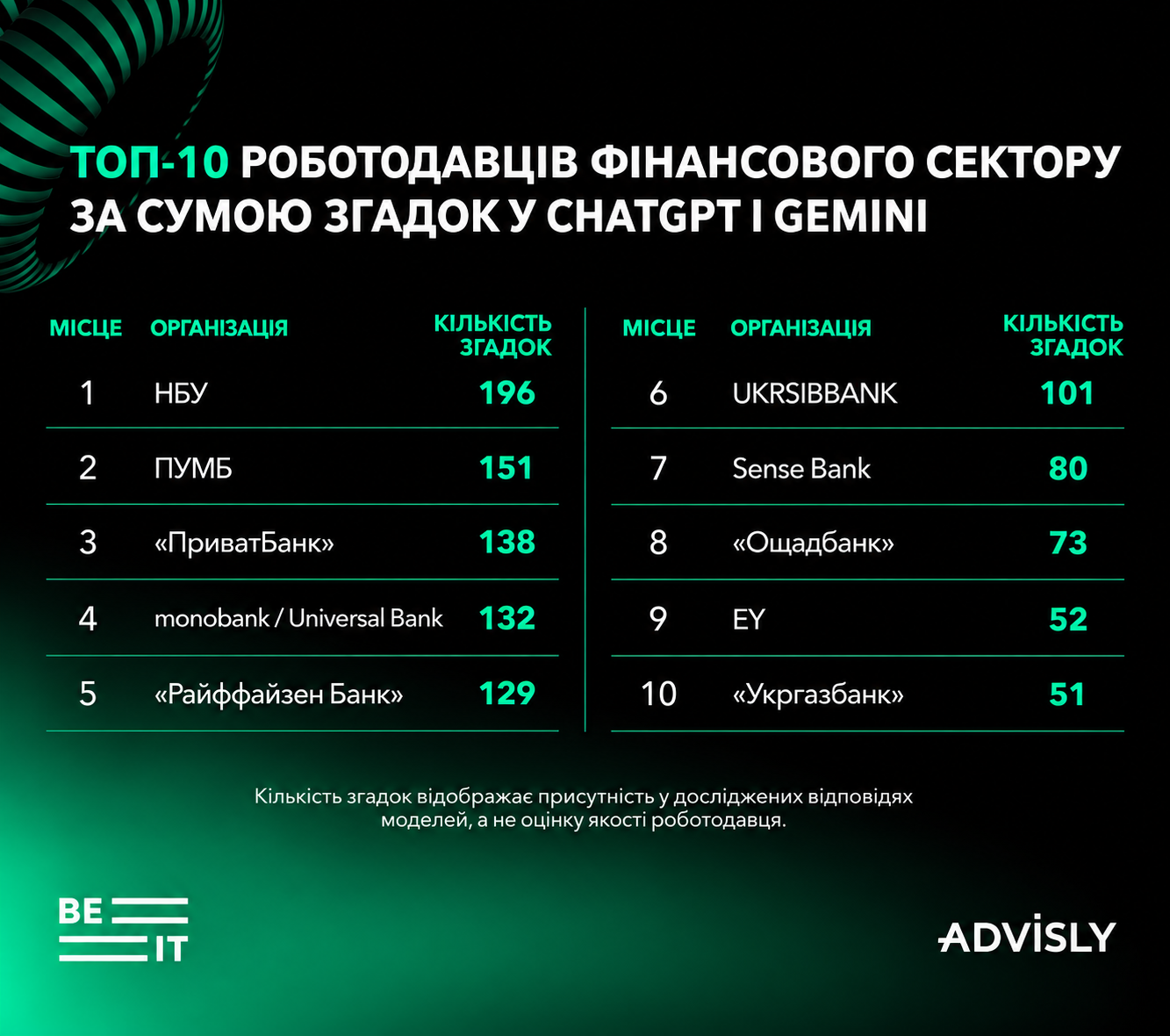
AI visibility of employers in agriculture, retail, and finance
Researchers separately analyzed three sectors – agriculture, retail, and finance. For each, they used additional queries on industry-specific topics, including questions candidates might have about veterans, internally displaced persons, inclusivity, starting salaries, frontline staff, and more.
AI output can also vary by model even within the same sector. This is especially noticeable in finance and retail: the set of most-mentioned brands largely overlaps, but the frequency of mentions and the context around them differ.
Corporate websites are just one part of the information landscape
Only 10% of citations in responses about employers come from official company websites. The rest come from external sources: media outlets, job boards, review platforms, and other resources.
Corporate websites don't appear among the top 10 most-cited sources. DOU, dev.ua, robota.ua, and Work.ua account for the most citations.
"These findings show just how closely AI visibility is tied to a company's overall reputation. A media feature, a job posting, or an employee review can all become sources for an AI-generated answer. That's why HR and communications teams should work together to check what picture these sources paint – and whether it matches the actual experience of working at the company. This also changes how communications should be evaluated: beyond reach, it's important to understand what perceptions of the company these materials help shape in AI responses," explains Krystyna Nikolaieva, Head of Strategic Initiatives and AI at VIRSHI, One Philosophy.
About the study
The Advisly and Be–it Agency study covered the general market as well as the agriculture, retail, and finance sectors. In the general block, ChatGPT and Gemini received 18 identical queries grouped into eight HR topics. For the sector deep-dives, researchers used an additional 16 queries for agriculture, 13 for retail, and 13 for finance.
Do you have a project?
LET’S TALK!